
AI Governance & Data Access
EnviStor runs AI agents in production — but never unsupervised. Reliability is treated as an architectural property, not a hope: agent knowledge, rules, and procedures are externalized into version-controlled artifacts, and every consequential action passes a human review gate before it becomes irreversible. This page explains how that works, and how data access is tiered.
Three levels of data access
Every dataset and application on the platform lives at exactly one of three access levels. Data moves outward — from private working state toward public FAIR publication — only through the review gates described below, never automatically.
Anyone on the internet
FAIR-published datasets and applications: Dataverse records with DOIs, ArcGIS Online layers, Pelican/OSDF objects, and public dashboards.
Access: No account needed. Citable, versioned, and license-labeled.
FIU internal network
Working data and internal tools during active curation: storage buckets, staging dashboards, and pre-publication drafts.
Access: Reachable only from the FIU campus network or VPN. Not indexed, not citable yet.
Named collaborators & partners
Sensitive or embargoed material: partner review sites, pre-release deliverables, and data with location, permit, or agency constraints.
Access: Username & password (or reviewer token) issued per person. Access is attributable and revocable.
Where humans sit in the workflow
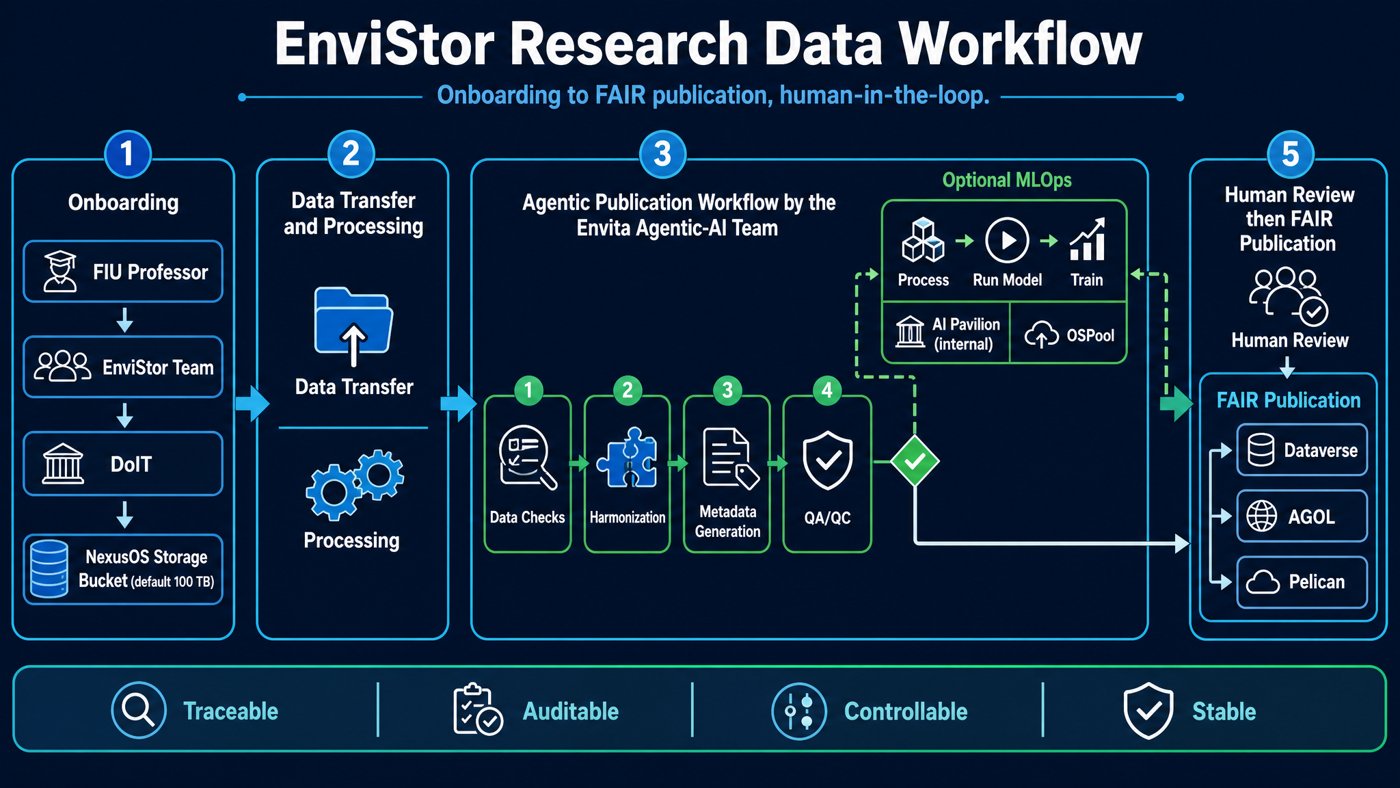
The end-to-end research data workflow — onboarding, transfer, agentic processing, and FAIR publication — is designed so that AI agents do the repetitive work while humans hold the decision points. The publication step is always behind a human review gate.
Human review gates
A review gate is a point where AI-assisted output cannot reach an irreversible or consequential state until a specific, named person takes an explicit, logged action. Four gate types are in daily operation:
Data curation quality gate
AI validates, transforms, and extracts; a named human cross-validates completeness, standards, and documentation before a dataset is marked approved.
Publication gate
Agent work stops at a draft. Irreversible public steps — publishing a Dataverse record, minting a DOI, releasing to ArcGIS Online — require an explicit human trigger.
Code & infrastructure gate
Changes to shared or production systems (deployments, deletions, credential rotations, live database edits) require human approval before they run.
Reviewer gate
External stakeholders review deliverables through login-gated pages where feedback and approvals are section-anchored and attributable to a named reviewer.
How agent reliability is engineered
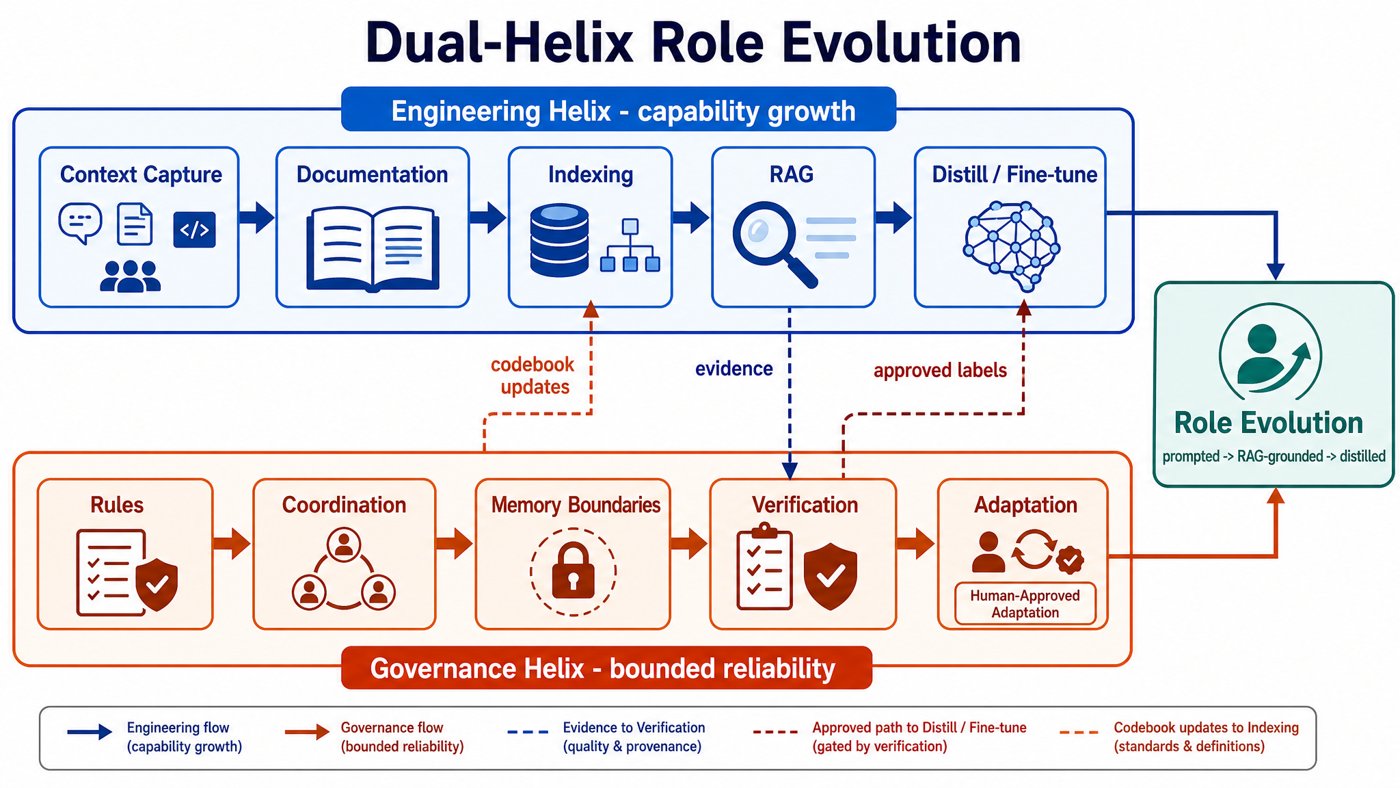
Agents are governed through a dual-helix design. An engineering helix grows capability — context capture, documentation, indexing, retrieval — while a governance helix bounds it with rules, memory boundaries, verification, and human-approved adaptation. Everything an agent knows and is allowed to do is externalized into three version-controlled tracks — knowledge (domain facts), behaviors (enforceable constraints), and skills (validated procedures) — so the agent’s conduct is auditable and reproducible rather than dependent on a model’s internal state.
AI-assistance disclosure
EnviStor works with government and institutional partners who have their own AI-use policies. Our disclosure practice, developed with those partners, follows five principles:
- ● Disclose, don’t disguise — public-facing deliverables produced with AI assistance carry a disclosure statement, following each partner’s AI-use policy.
- ● Humans make final decisions and are fully responsible — every AI-produced change is human-approved before it is published.
- ● Sensitive or confidential data (precise locations, permits, personal information) never enters external AI tools; the boundary is explicit and documented.
- ● AI-policy decisions for partner projects are made with the partner, never unilaterally.
- ● All project communication is written assuming public-records visibility.
Provenance is kept end-to-end: datasets, documents, and applications record what the AI did, what a human reviewed, and who approved the release. Questions about access levels or AI governance for a specific project? Contact the team via the FAQs page.